Zombie asks cinema to stop making every film about his dietary requirements.
“I contain multitudes,” says man whose entire screen representation is apparently one long buffet queue.
This is an invented story. Events, characters and quotations are fictional. The illustration is AI-generated. Please do not call the supermarket.
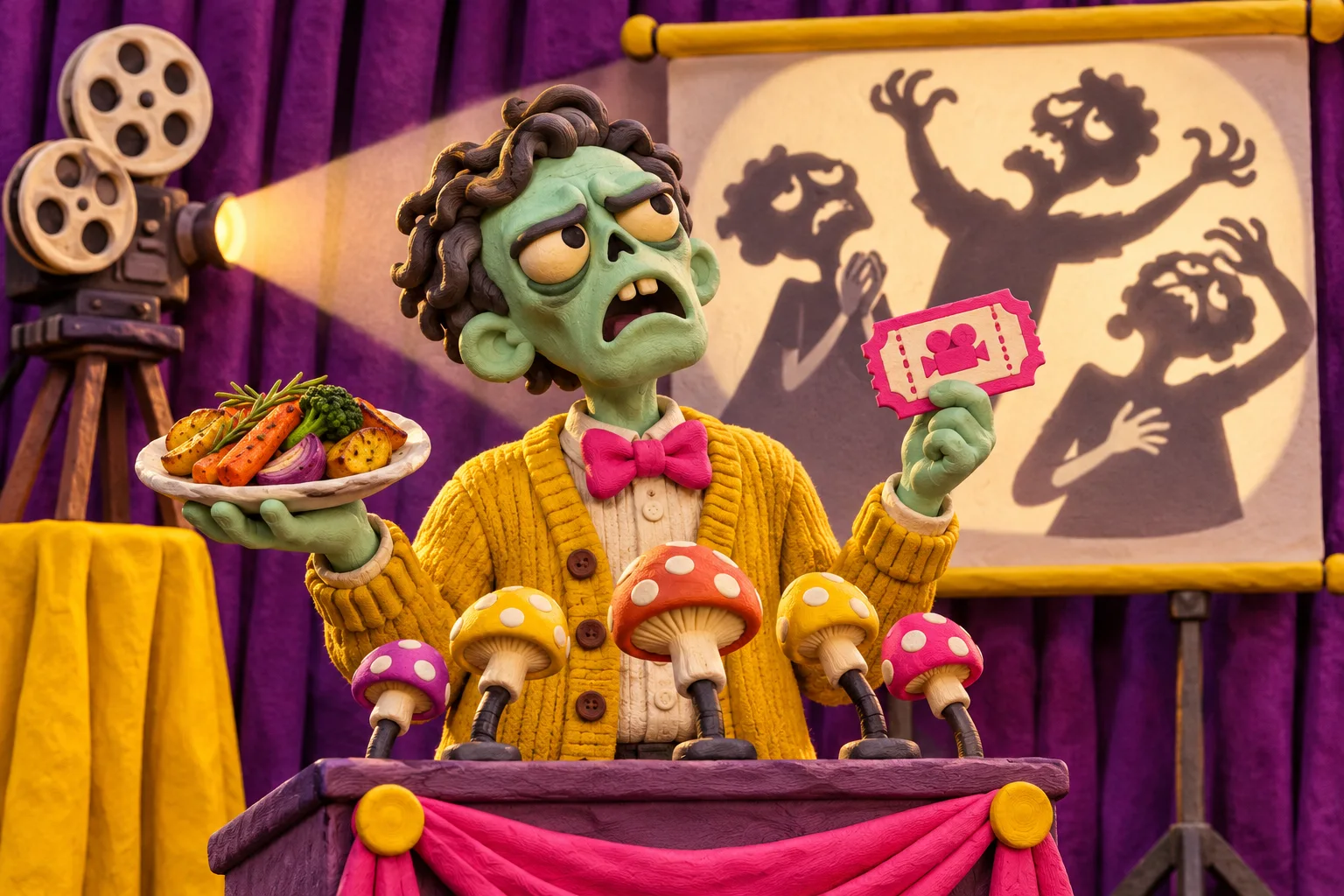
He has brought notes. And a quiche.
Gerald, a fictional zombie, has lodged a formal complaint with his local cinema after discovering that the latest undead thriller contains no scenes of anyone doing their tax return, pursuing a hobby, or simply having a reasonably pleasant afternoon. Instead, it spends its entire running time suggesting that people like Gerald are interested exclusively in chasing strangers through poorly lit corridors.
“I am a complicated person,” he told a press conference attended by four reporters, a mushroom microphone, and someone who thought the room had been booked for Pilates. “I like ceramics, slow radio, and a vegetable quiche with a firm base. My relationship with brains is considerably less central to my identity than these films would have you believe.”
He distributed a twelve-page document titled We Can Be Other Things, accompanied by a diagram of a perfectly ordinary Wednesday. The diagram included returning a library book, repotting a fern, and spending forty minutes choosing a password. At no point did it include breaking through a boarded window.
The apocalypse has become a scheduling problem.
Gerald’s principal objection is not that fictional zombies are allowed to be villains. It is that they are so rarely allowed to have anything else going on. He counted fourteen recent imaginary trailers in which an undead character’s entire biography could be summarized as “arrived near a fence.” None disclosed whether the character had previously been involved in community theatre.
“Every time a film comes out, my neighbours start moving furniture against their doors,” he said. “Then I have to ring them because the sofa is blocking the shared hallway. It makes a very awkward conversation even more awkward when you are already holding a borrowed lasagne dish.”
His neighbour Mavis, also invented, confirmed that Gerald had been unfairly judged. She described him as a considerate resident who had once spent an entire weekend helping label the communal recycling bins. “The only thing he has ever aggressively pursued,” she said, “is a clarification about whether a yogurt lid goes in plastics.”
Several alternative pitches are available.
To demonstrate that the industry has options, Gerald has written a romantic comedy about an undead man who accidentally joins two book clubs. Its central conflict concerns whether he can finish both novels before Thursday. A producer reportedly asked whether the novels could explode. Gerald responded by adding a third book club, which he considers more frightening.
His second proposal is a quiet domestic drama called The Good Bowl. Over ninety-two minutes, a zombie learns to make a bowl, makes a bowl, and is mildly unhappy with the glaze. The emotional climax occurs when his teacher explains that irregularity can be part of the appeal. No helicopter appears, although Gerald says he could be flexible about a distant helicopter.
A third concept, currently written on the back of a receipt, follows a group of undead friends trying to organize a picnic through a group chat. Six people say they can do Saturday. One person says “either day works” and then rejects both days. Gerald believes this premise offers sufficient existential horror without any makeup effects.
The cinema has issued a very careful statement.
The imaginary cinema said it welcomed feedback from all audiences, including those who had “experienced a nonstandard relationship with being alive.” It offered Gerald two complimentary tickets, a small popcorn, and the opportunity to appear in a promotional photograph looking pleased beside the very poster he had complained about.
Gerald declined the photograph but accepted the popcorn, describing this as a practical distinction rather than a collapse of principle. He then asked whether the cinema would host an undead film season. Management suggested a Halloween marathon. Gerald suggested February, when people might be emotionally prepared for a story about glazing a bowl.
The discussion briefly stalled over accessibility. Gerald requested longer intervals between screenings, less dramatic automatic doors, and seats that did not loudly fold up when he stood to stretch. The cinema promised to look into the doors. The doors, according to a source close to the doors, were already doing their best.
What Gerald wants is surprisingly modest.
By the end of the press conference, the original twelve-page complaint had become a conversation about the right of fictional monsters to be boring. Gerald does not want every zombie to become admirable. He would simply like one to be late for an appointment because the bus was late, rather than because the bus was on fire.
Asked whether he intended to boycott the next undead blockbuster, he said he might still go. He likes the cinema. He likes sitting in a dark room where nobody expects him to answer an email. He also remains curious about whether the film’s lead zombie will finally be given a name other than a description of a noise.
Gerald packed his quiche into a reusable container and left for his pottery class. The reporters agreed that he had made a persuasive case. Unfortunately, the first proposed headline was ZOMBIE DESCENDS ON CINEMA. Gerald has requested a second meeting. He is bringing a different quiche. This one has mushrooms, which may complicate the microphone situation.
Original fiction published by Shitpost Games. This is comedy, not reporting or game advice. For actual mechanics, read the game guides.